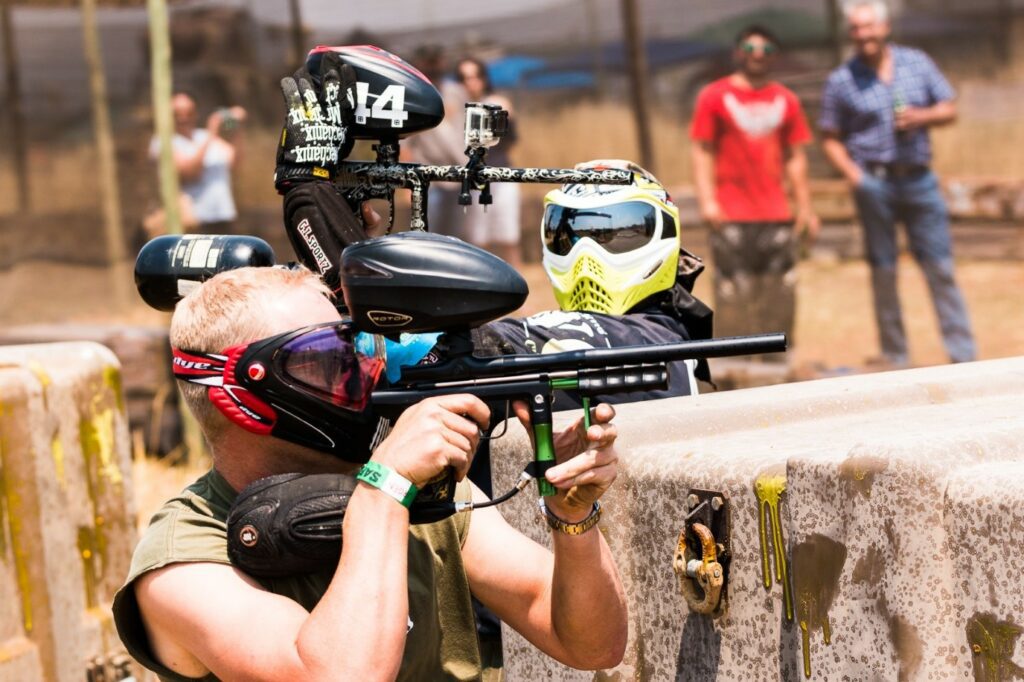
Paintball Photography types of Paintball
There are a few different types of paintball sports / fun games that have we can do Paintball Photography at.
- Bushball (Woodsball) – Usually occurring in a bush or woods area.
- Speedball – In a specifically laid out field using rubber type bunkers using a specific marker designed for the sport played with between 1 player to 5 players per team. Players usually go through huge amounts of paintball ammo.
- Scenario – Different layouts, styles rules etc. Could be boards, tire’s, buildings etc.
- MilSim (Military Simulation) – Usually Mag-Fed markers – limited amount of paintball ammo.
- Concept
Each of these requires different photographic techniques to get the best photographs of. Also, the type of field and number of players can dictate variations to what you do as a photographer and what Len’s you should pick.

Paintball Photography general considerations
For Paintball Photography always get permission from the field owners / tournament organizer to be able to take photos on the field. Also some tournaments limit the number of photographers on the field or only use approved photographers.
Definition of the field is mostly the area that is within a finely netted area protecting spectators on the outside of being hit by a paintball. (The field – otherwise known as the players area).

For Paintball Photography there are exceptions to a netted area. These exceptions are very large scenario games which then have a 30m no-man’s land between spectators and players.
Paintball Photography Considerations
- Firstly, ALWAYS BE SAFE.
- Always wear an approved mask on the field. DO NOT remove your mask while on the field.
- Listen to any other instructions from the Referee’s before entering the field.
- Obey the regulations for the type of field and type of paintball game.
- Use appropriate Clothing. (To assist in minimizing pain when hit by a paintball).
- Be padded up.
- Use bright colours.
- DSLR camera with a Telephoto Lens.
- 70-300mm
- 70-200mm
- 50-250mm
- Etc.
- If brave use a wide-angle lens in certain circumstances.
- Camera / Lens protection.
- Depending on your personal preferences use a towel to cover the camera.
- I prefer not too, as the towel can be a huge nuisances factor. My camera has taken numerous hits and is still working perfectly. In some cases the heavy amount of paint, just wipe off. Where paint gets into cracks etc. wait for the paint to dry and use a soft toothbrush to clean out.
- I prefer not too, as I believe that my professional lenses can handle the hit, and that a smashed UV filter could scratch the Lens. My lens has taken a number of hits with no damage sustained.
- Always use a good quality strap.
- Chances are that you can drop the camera when hit by a paintball, or by tripping over obstacle’s etc.
- Depending on your personal preferences use a towel to cover the camera.
- Either try watching or playing a few games yourself to familiarize yourself to what happens on the field.
- I have personally played a number of paintball game variations and still continue in my own time.
- This gains a lot of respect from the professional players.
- Also, you understand what the players go through.
- And most importantly (my opinion) you lose your fear of being hit by a paintball and then automatically start taking better photos.
- I have personally played a number of paintball game variations and still continue in my own time.
Paintball Photography know the Field
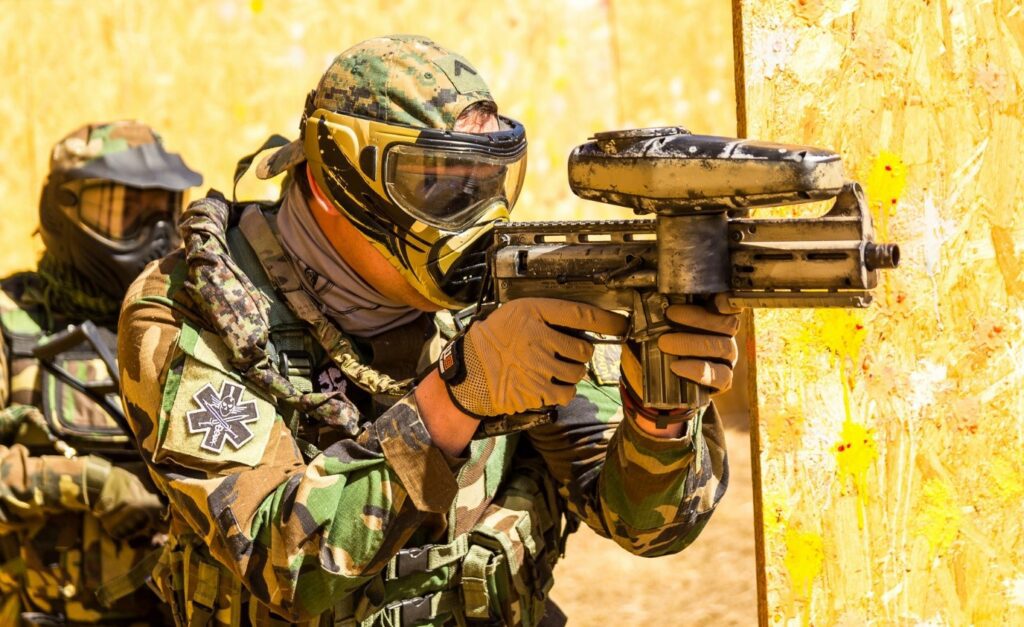
For Paintball Photography you need to know the field.
- Where possible walk the field before any players go on the field to familiarize yourself, especially for Speedball.
- Try to get a feel of where the players will be shooting from.
- Based on where the players operate from you can determine where you are going to take photos from.
- Try to determine possible favourite spots (Use possible excessive paint spots as an indication).
- Double check with the referee’s where you are allowed to take photos from. i.e. Speedball tournaments enforce that you must stay outside of the beaconed off area. (Same as a Rugby etc. field) but you are still within the netted area.
- In a great deal of fields be aware of possible dangerous objects, holes, heights, hills etc. (Your own safety should always be your top priority).

Taking Photos
For Paintball Photography you need to know the following: –
Camera Settings
- Generally, use Aperture priority mode.
- Use RAW capture.
- Set the lens to the minimum focal length and then set for the widest aperture if your lens is not a fast lens. (This allows for lenses that have a maximum aperture range for the focal lengths to always choose the correct maximum aperture depending on the focal length).
- For those that have fast glass – Set aperture to about f3.5 – f4.0 for Speedball and a little lower for other forms of paintball.
- Set your exposure to 0.0 to +0.3 on Canon cameras. (Slightly lower on Nikon). – This allows for changing light conditions on the field and makes editing later easier. (Don’t worry if your photo looks a little overexposed – but must not be overly exposed).
- Push your ISO a bit (200-400 ISO in good daylight) – make sure your shutter speed does not go below about 1/800th of a second.
- Doing pan photography in paintball photography is very difficult as there is too much direction changing in the sport.
- Set focusing to AI Servo.
- Try use back focus if possible (Don’t start using it in sport photography unless you have had some practice with it).
- Based on these settings, you are making the camera work for you – allowing you to concentrate on capturing the action.
- Use on camera flash in darkish buildings (Push ISO to a minimum of 800 ISO)
Move Around
- Move around the field if there are few players.
- With a large number of players, you can pick a general spot to work from, depending on the size of field.
- On Speedball fields, you are going to move around a lot, also you will have to lay on the ground sometimes or take photos on your haunches, remember to also take from the other side of the field.
- Except for Speedball move within the field if the referees allow you to.
- Don’t be scared – you will get better photo’s if you are not scared.
- Zoom in and out allot.
- Keep your eyes open for possible interesting shots.
- Anticipate specific moves by the players and get yourself ready for those moves.
Awareness
- Again, Safety First.
- Always be aware of your surroundings.
- Be aware where possible of other photographers – mainly be reasonable to others with understanding. If a photographer accidently gets in your way it is not the end of the world – in general he did not do it purposely or was not aware of you (he was a few feet in front of you and was concentrating what is happening in front of him).
- Again, keep your eyes open for possible interesting shots.
- Again, anticipate specific moves by the players and get yourself ready for those moves.
Know your camera / lighting conditions
- Most first-time paintball photographers loose amazing shots because they don’t trust their knowledge and are constantly chimping.
- There is too much else going on to worry about camera settings or lighting conditions.
- You will get badly shot if you don’t know your camera or lighting conditions, because you will not be aware of where the players are and the lanes of fire that they have chosen. Also, you could aggravate other photographers or get aggravated by other photographers.
Decide what purpose you have
- Capturing for a team / s.
- Make sure you get multiple photos of each team member.
- Height of action.
- Be ready for the action at the best spots.
Remain neutral at all times
- Try as far as possible not give away a player’s position.
- Do not stare at a player if no one is aware of his position.
- You are not a Referee leave that up to the referee.
- Only get involved if someone’s safety is at risk.

Tips and Tricks
Tips and tricks for Paintball Photography: –
- Try not to do machine gun shooting, it just runs up your photos into the thousands very quickly.
- Only do slow burst shots on running, diving and where paintballs are flying.
- I usually use my shutter finger to emulate burst shots as that does not run up the number of photos taken as much and is more than adequate to get the action photos. (Deliberate shooting).
- With small number of players on large fields, use a small lens, run with the players where permission given. Take photos from relatively safe positions. (Your chances of getting shot here is greater).
- Professional players are a lot less likely to shoot at you than casual beginner players. Stay rather to the sides of fields when beginner players are on the field.
- If you are within a field between players, do not do any rash moves, but be slow and allow the players to be aware of you. Professionals might shoot past you, which makes it important to move slowly. Don’t get scared. Use the opportunity to get even better photos.
- On speedball fields.
- Capture the break and running to the bunkers laying down.
- Capture photos on each game from different positions on the side of the field.
- If you are going for snake dives, position yourself for it and do burst shots.
- Snake side usually does not get dives into it on games with less than 5 players on a team.
- Avoid being behind back corner bunkers – you will get shot.
- Mainly get photos from Snake and D-side sides.
- Sometimes photos at the 50 (half way) are very cool. Try to zoom out quite a bit to catch players at both sides of the wall.
- On large scenario fields / games.
- Be prepared to walk around a lot.
- Listen for and try determine possible game hot spots.
- Drink a lot of fluids. If not, you will end up dehydrated.